
SCIENCE
-

Ask Ethan: Can we solve the mysteries of the largest black holes?
Back in 2004, a supermassive black hole from 10.8 billion years ago was found, weighing in at 66 billion solar…
Read More » -

Ask Ethan: Could we spot an extinction-level asteroid?
65 million years ago, a massive asteroid struck Earth, causing a mass extinction. Without advance warning, could anyone have spotted…
Read More » -

How to not overestimate the number of stars in the Universe
With ~400 billion stars in the Milky Way and 6–20 trillion galaxies overall, that makes for a lot of stars.…
Read More » -

Could nearby relic galaxy NGC 1277 lead to the first stars?
At 240 million light-years away, galaxy NGC 1277 hasn’t formed new stars in over 10 billion years. Could it contain…
Read More » -
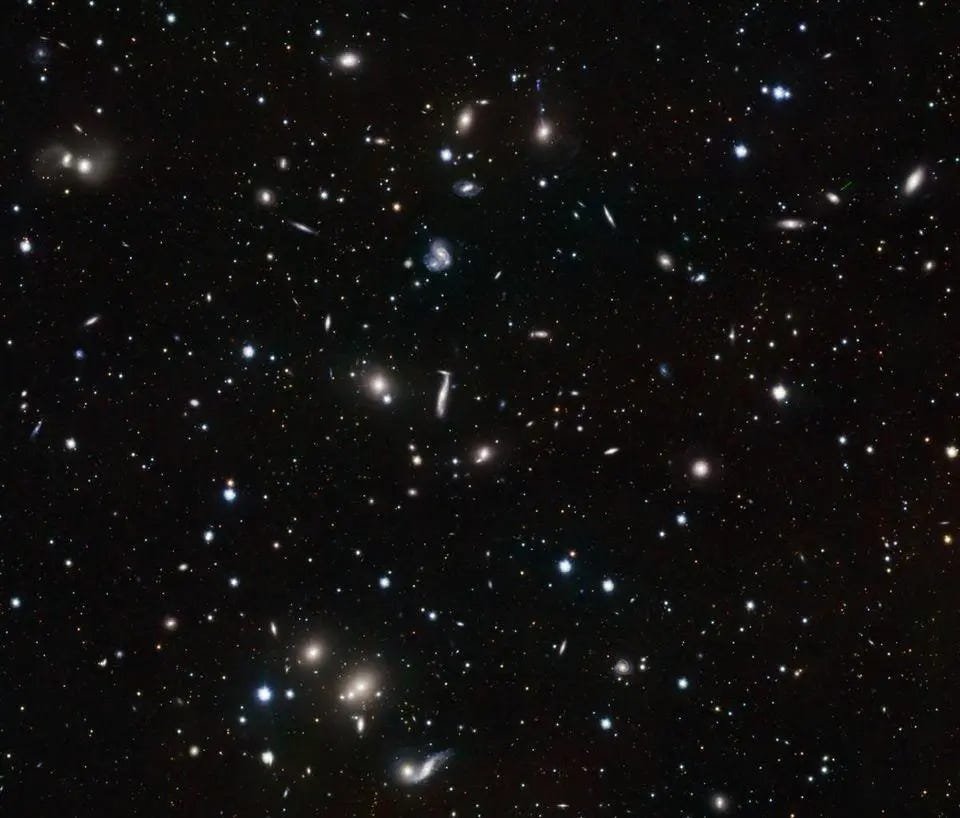
Ask Ethan: What super-galactic structures are we a part of?
We live on Earth, orbiting the Sun, part of our Solar System, within the Milky Way. But what’s our membership…
Read More » -

Yes, interstellar comet 3I/ATLAS is older than the Solar System
Interstellar comet 3I/ATLAS has an ancient age, but not for the reason most commonly touted. These three lines of evidence…
Read More » -

Ask Ethan: How do space telescopes stay focused?
With targets from all across the Universe, focusing a space telescope — with so many moving parts — is challenging,…
Read More » -

Rarest elements reveal planets eaten by white dwarfs
Despite their rarity, boron and beryllium can both be detected within white dwarf atmospheres. What does their presence and abundance……
Read More » -

Ask Ethan: How are black holes active if nothing escapes from them?
Once you cross over to the inside of an event horizon, you can never come out again. But then, how…
Read More » -

Move over, giant meteor. Here’s what the largest comet would do to Earth
Oort cloud object Bernardinelli–Bernstein has the largest known cometary nucleus: 119 km wide. An impact with Earth would be catastrophic.…
Read More »