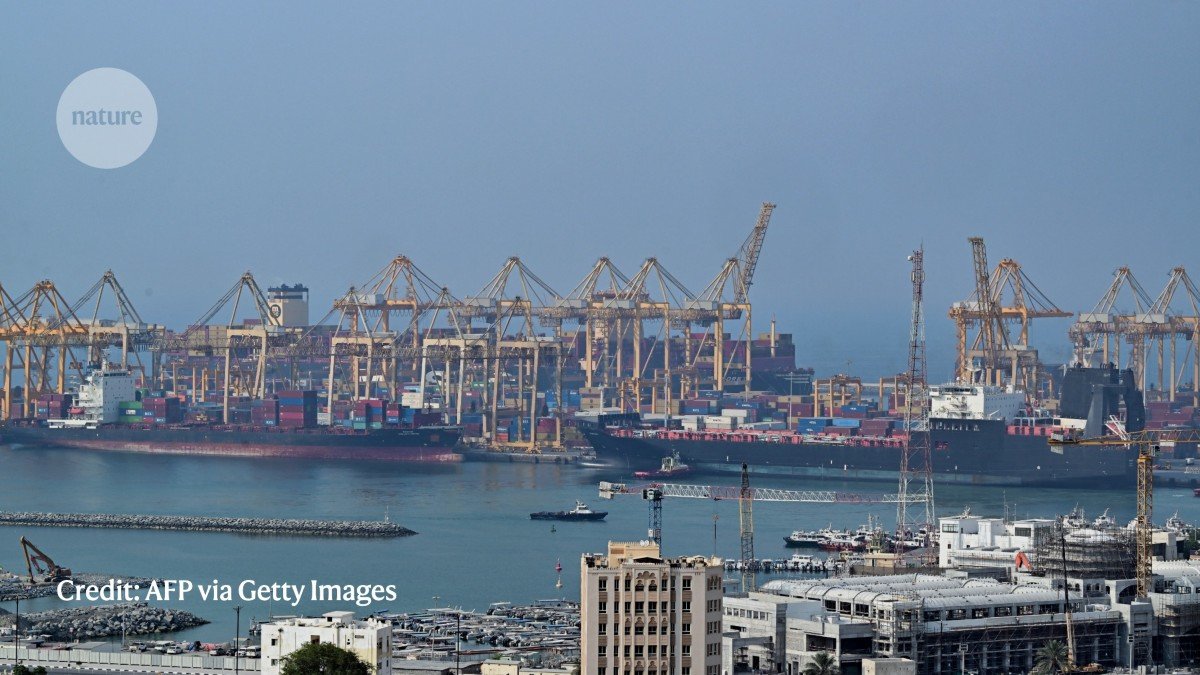

Container ships were forced to dock at ports in the United Arab Emirates and other Middle Eastern nations after the Iranian government announced that it would close the Strait of Hormuz in July.Credit: AFP via Getty Images
Protesters burnt tyres and blocked roads in Syria over fuel prices. French fishers blockaded a fuel depot and clashed with police. Government and household budgets were squeezed around the world as interest rates rose and the sales of electric vehicles roughly doubled year-on-year in several countries, including Australia, Brazil and India.
These were just some of the many knock-on effects of the US and Israeli airstrikes on Iran that began in February. The closure of the Strait of Hormuz, through which about 25% of the world’s oil trade and 20% of exported liquefied natural gas previously passed, caused what the International Energy Agency (IEA) called “the largest supply disruption in the history of the global oil market”, as fuel prices spiked worldwide.

Nature Spotlight: Energy
The resulting strain has exacerbated the economic pressures already felt from previous shocks, including the Russia–Ukraine war, the COVID-19 pandemic and the 2008 global financial crash, as well as from the continuing effects of climate change. The current global energy-security picture is “really bad on all fronts”, says Dan Marks, an energy-security researcher at the Royal United Services Institute, a think tank based in London. “It’s something of a perfect storm.”
Governments seeking to improve national energy security are taking a variety of approaches — from measures to reduce demand and increase electrification to infrastructure updates and incentive programmes to encourage renewable-energy investment. Researchers, meanwhile, are doing their bit, driving scientific and technological advances that have the potential to deliver a stable and sustainable future energy mix.
What is energy security?
Human energy consumption is both growing and changing (see ‘Powering the planet’). Use of global primary energy — naturally occurring energy sources that have not undergone any processing by humans — more than doubled between 1980 and 2025. Over that period, consumption increased from around 85,000 terawatt hours (TWh) annually to 178,000 TWh. That’s approximately 71 times the yearly primary-energy consumption of France.
Electrification — the replacement of technologies that burn fossil fuels with alternatives powered by electricity — is advancing in many countries as various industries look into switching to renewables. Worldwide, electricity demand is predicted to increase by around 40% by 2035, compared with current levels (see ‘The road ahead’). Despite this, many industries are still reliant on fossil fuels. Close to 99% of aviation and more than 90% of shipping relies on fossil fuels, for example. One-quarter of extracted natural gas is used to heat industrial buildings, and around 21% is used for heating and cooking in homes worldwide. Most of the rest (40%) is used to generate electricity. Although the share of primary energy generated by renewables is growing, oil, coal and gas still account for about 80% of energy production.

Source: Our World in Data
The IEA defines energy security as reliable, affordable access to all fuels and energy sources. Marks and others highlight that priorities vary internationally, with reliability often seen as of primary importance in high-income countries and affordability taking precedence in low-income nations. The impacts of global shocks to fuel supplies and prices also vary according to how reliant countries are on imported fossil fuels. “There isn’t one global energy-security picture, but many different context-dependent pictures,” says Severin Borenstein, an energy economist at the University of California, Berkeley.
Economies that rely on imported oil products are particularly vulnerable to the current shocks. The World Food Programme, part of the United Nations, estimated in March that the US–Iran war could push an extra 45 million people into acute hunger, taking this year’s total to 363 million, as increasing oil and gas costs push up the prices of fuel, food and other crucial products such as fertilizer. “If, like in a lot of African countries, people are dependent on travelling long distances in vehicles and on other imported oil products, large oil-price increases can be existentially problematic,” says Marks. Some high-income nations have also been hit hard. In Japan — which was importing more than 90% of its crude oil from the Middle East before the conflict — household electricity bills have risen to their highest levels in three years, and government borrowing costs have risen to a 30-year high.
By contrast, nations with domestic fuel supplies have been partially insulated. Although car users in the United States have seen big fuel-price increases, the country’s ample supplies of natural gas have shielded the nation from severe economic hardships. “In most developed free-market economies, there isn’t an energy-security issue in the sense of availability,” says Borenstein. “There are price and macro-economic issues. Some countries, like the United States, are better protected than others.”

Source: IEA, CC BY 4.0
Global oil prices have jumped since the US–Iran war broke out. Brent Crude futures contracts, a global oil-price benchmark, hit US$126 a barrel in April — up from around $70 before the conflict. This has affected consumers and businesses, but not as much as some previous energy crises. During the Yom Kippur War, coordinated action by oil-producing countries caused prices to more than triple between October 1973 and January 1974. And oil prices more than doubled after the 1978–79 Iranian revolution.
Many economists think that the global economy is better placed to avoid the soaring inflation, unemployment and recessions seen in many industrialized nations after the 1973 and 1979 oil shocks. The ‘oil intensity’ of the global economy, that is, how much oil is needed to generate a unit of gross domestic product (GDP) in the form of goods and services, has fallen by more than 50% since the 1970s. And the IEA, established after the 1973 oil crisis, also requires its 32 member countries to keep reserves of at least 90 days’ worth of crude oil to guard against supply shocks. “For most of the developed world, it’s a big inconvenience, and, for some, a substantial budget squeeze, but it’s not the complete disruption of the economy seen in the 1970s,” says Borenstein.
But economic and energy-security challenges are also expected to grow owing to climate change. Droughts are becoming more frequent and severe, resulting in big reductions in hydropower generation in nations such as China, Brazil, the United States, Spain and Zambia. Low water levels in rivers, including the Rhine and Danube in Europe, the Amazon in South America and the Yangtze in China, have caused freight delivery problems. The other effects of climate change include reduced wind-energy generation and increased demand for power to run air-conditioning units.
Governments, policymakers and others who are working to tackle energy-security challenges have various options. Reducing energy demand, especially for oil and gas, by electrifying industrial processes and home heating, for example, helps with these issues, especially in nations that are heavily reliant on imported fossil fuels. Managing demand volatility through improved energy storage and ensuring that power grids can transition towards greater energy generation from renewables are also part of the picture, Marks says.
Generating security
Although governments and business leaders have parts to play in energy-demand management, electrification and infrastructure investments, researchers are driving scientific and technical innovations that support energy security. Tapping underground heat to produce geothermal energy, for example, emits only small amounts of greenhouse gases and can be used to generate electricity or to heat buildings. However, at present, geothermal energy produces less than 1% of electricity globally because few locations have the right combination of accessible underground heat, water and permeable rock.
That could change thanks to advances in enhanced geothermal systems (EGS), in which underground fractures are expanded or created in hot areas, and then fluids are pumped down, heated up and transferred back to the surface, usually to drive turbines and generate electricity.

Russia has been experiencing a fuel crisis since mid-June caused by increased Ukrainian drone attacks on oil refineries. Credit: Contributor/Getty Images News
There have been small-scale EGS research operations since the 1970s, but drilling times and costs have fallen substantially in the decades since thanks to techniques adapted from the oil and gas industries. These include the fracturing of rock with pressurized fluids, known as fracking, horizontal drilling to increase the exposure of fluid to heat reservoirs and the use of tougher, faster polycrystalline diamond compact drill bits. “It’s hard to overestimate how much of a game changer the new techniques have been,” says Roland Horne, a geothermal-energy engineer at Stanford University in California.
These innovations are driving investments in large commercial plants. One of the biggest of these is the Cape Station project operated by Fervo Energy near Milford in Utah, which began delivering power in September and plans to build the capacity to generate 500 megawatts (MW) by 2028 — enough electricity to power around 500,000 US homes.
However, there are obstacles to overcome. A number of EGS projects have been halted owing to earthquakes that geologists linked to increased underground forces generated by the EGS process. A magnitude-5.5 earthquake that injured 90 people was probably triggered by hydraulic fracturing at an EGS plant in Pohang, South Korea, in 2017. Lessons have been learnt from this and other incidents. For example, EGS developers are deploying networks of sensors to better predict seismic risks and using multistage stimulation. This involves the use of pressurised fluids or chemical agents to fracture rock sequentially and more gently at several points rather than at fewer locations.
Horne says that he expects the levelized cost of electricity — the average cost of generating a unit of electricity across a power plant’s lifetime — for EGS to drop to a commercially competitive $80 per megawatt hour (MWh) by 2027. The IEA says that this could drop to $50 by 2035 and that geothermal energy could generate 8% of global electricity supplies by 2050.
Efforts to develop more efficient solar cells could also help countries to improve their energy security by increasing sustainable domestic electricity supplies. In 2025, 9% of the world’s electricity came from solar, up from 3% in 2020. Today’s solar cells are mostly silicon-based and can typically convert light into electricity with efficiencies of around 20–24%.

A worker inspects newly installed solar panels at the Fuendetodos II solar park near Zaragoza, Spain.Credit: Angel Garcia/Bloomberg via Getty Images
When sunlight hits a solar, or photovoltaic, cell, electrons inside the semiconductor material that it is made from are knocked loose, creating an electrical imbalance that produces a voltage and generates electricity. Researchers are now developing next-generation solar cells that use metal halide perovskites, a family of crystalline compounds with high light absorption and charge-transport capabilities.